
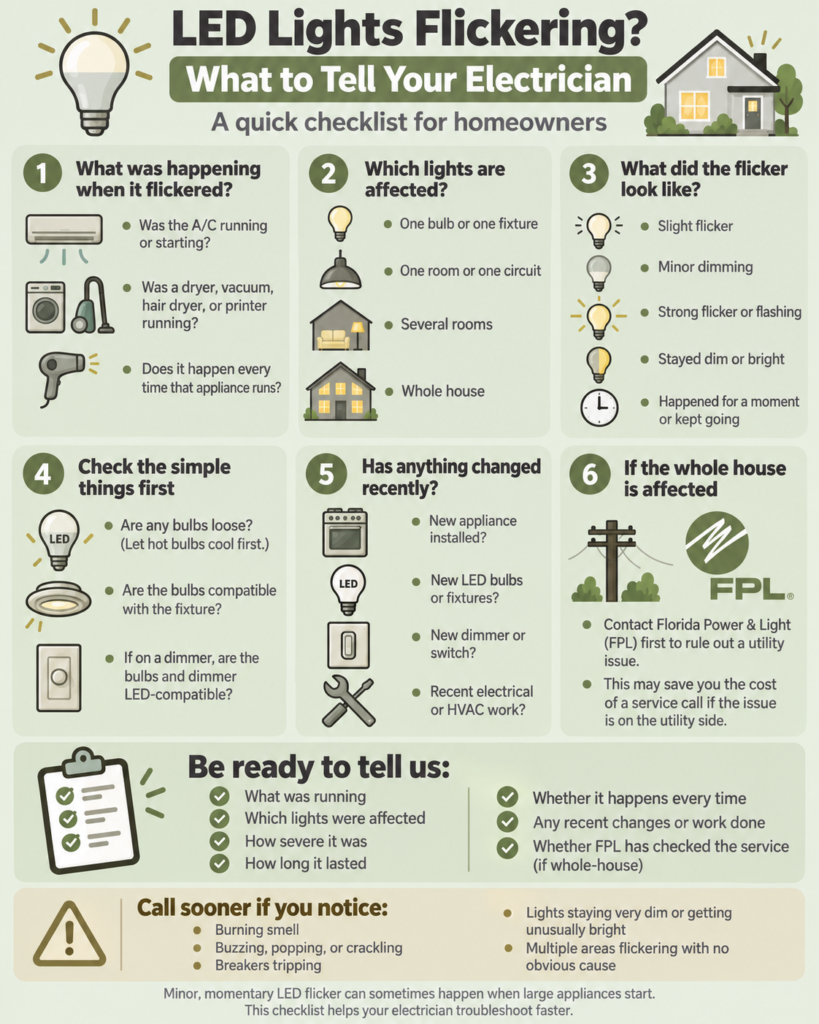
Why Are My LED Lights Flickering? When It’s Normal—and When to Call an Electrician
You turn on the air conditioner and notice the bathroom lights dip for just a moment. Someone starts the vacuum and an LED light seems to flutter. A hair dryer turns on, the printer starts, or another appliance begins running—and the lights briefly change brightness.
Does that mean something is wrong with your electrical system?
Not necessarily.
This is something we occasionally hear from homeowners, particularly in newer homes with LED lighting. Modern LEDs are extremely energy-efficient, but they are also very sensitive to small changes in the electricity supplying them.
Because LEDs react very quickly to those changes, they can sometimes make a brief voltage fluctuation visible as a slight flicker or momentary dimming.
In many cases, that is simply a nuisance. In other cases, flickering can be a sign that something needs to be investigated.
The important question is what kind of flicker you are seeing and when it happens.
Why Do LEDs Seem to Flicker More Than Older Lights?
Older incandescent bulbs made light by heating a filament. That filament stayed hot for a short period of time, which naturally helped smooth out very small changes in the electrical supply.
LED lighting works differently.
An LED uses electronic components called a driver to convert the incoming electricity into the power the LED needs. LEDs respond extremely quickly to changes in that electrical current.
As a result, a small change that may never have been noticeable with an incandescent bulb can sometimes appear on an LED as:
- A quick dip in brightness
- A very slight flicker
- A brief shimmer
- A momentary change when another appliance turns on
That does not automatically mean there is anything wrong with the light fixture or the home’s wiring.
Sometimes the LED is simply sensitive enough to show an electrical fluctuation that an older style of bulb would have masked.
Why Does the A/C Make My Lights Flicker?
Air conditioners, heat pumps and other equipment containing motors can require a large amount of current for a brief period when they start.
That initial demand is commonly called inrush current.
The temporary increase in electrical demand can cause a very brief voltage drop, often called a voltage sag or voltage dip.
Your LED lights may react quickly enough for you to see it.
The same general principle can apply when other electrical equipment begins operating, including:
- Air-conditioning equipment
- Heat pumps
- Clothes dryers
- Vacuum cleaners
- Hair dryers
- Printers and office equipment
- Power tools
- Other motors or high-demand appliances
Not every appliance affects the electrical system in exactly the same way. However, when a substantial electrical load starts or changes operating states, a sensitive LED driver can sometimes respond with a brief visible change.
FPL also notes that voltage fluctuations can cause lights to temporarily dim or brighten.
In a New Home, Is a Slight Flicker Normal?
It can be.
New homes commonly use LED lighting throughout the house, including LED bulbs, wafer lights and surface-mounted LED fixtures.
That means homeowners may notice very small electrical fluctuations that would have been much less obvious in homes primarily using incandescent lighting.
For example, if a bathroom LED gives one slight flicker when the air conditioner starts and immediately returns to normal, that alone does not establish that there is a wiring problem.
If the electrical connections have been inspected, no defect is found, and the symptom remains minor, brief and associated with a particular appliance operating, the flicker may simply be a characteristic of the LED responding to a temporary change in voltage.
First Question: What Is Happening When the Light Flickers?
One of the most useful things a homeowner can do is look for a pattern.
Before calling for service, pay attention to:
What is running when the flicker happens?
Does it happen when:
- The A/C compressor starts?
- A vacuum turns on?
- A hair dryer is being used?
- The clothes dryer starts?
- A printer or other office equipment operates?
- A particular appliance turns on?
FPL specifically recommends looking at what household equipment is operating when an electrical disturbance occurs and whether sensitive equipment may be sharing a circuit with larger loads or motors.
A repeatable pattern can provide an electrician with an important clue.
Which Lights Are Affected?
This is another important distinction.
One bulb or one fixture
If only one LED bulb or fixture flickers, the issue is more likely to be associated with that particular bulb, fixture, connection, driver or dimmer.
Several lights on the same circuit or in the same room
This may point toward something affecting that branch circuit or a load operating on or near that circuit.
Lights throughout the house
If lights throughout the home are noticeably dimming, brightening or flickering, the source may not be an individual LED fixture at all.The problem could involve the home’s electrical service or the utility’s electrical system.
FPL distinguishes between brief utility power “flickers” and voltage fluctuations. A voltage fluctuation is a dip or increase in the electricity supplied to the home and can cause lights to dim or become brighter.
How Severe Is the Flicker?
Try to describe what you actually see.
There is a significant difference between:
A tiny, momentary flicker
and
A dramatic change in brightness throughout the house.
A slight flutter or very brief dip associated with a large appliance starting is generally less concerning than lights that repeatedly flash, become very dim or suddenly become unusually bright.
Ask yourself:
- Is it just a slight flicker?
- Do the lights dim very briefly?
- Do they flash noticeably?
- Do they remain dim?
- Do some lights get brighter while others get dimmer?
- Does the flickering continue for several seconds or minutes?
Those distinctions matter when troubleshooting the cause.
If the Whole House Is Affected, Contact the Utility
If the problem appears to affect the entire house rather than one fixture or one circuit, it can make sense to rule out a utility-side problem before paying an electrician to investigate something outside the home’s electrical system.
For homes in our area that are served by Florida Power & Light (FPL), homeowners can report recurring flickers or voltage problems directly to FPL.
FPL recommends contacting them when customers experience recurring power problems, and the utility can investigate conditions on its side of the electrical service.
This can potentially save the homeowner the cost of an electrical service call if the problem originates with utility equipment rather than the home’s wiring.
If FPL checks its equipment and finds no problem, the next step is generally to have a licensed electrician investigate the home’s electrical system.
Check the Simple Things First
Before scheduling service for one flickering fixture, there are several basic things worth checking.
Is the bulb loose?
A loose bulb can make intermittent contact and cause flickering.With the light turned off, make sure the bulb is properly seated in the socket.
Be careful: bulbs and fixtures can become hot. Allow them to cool before touching them.
If you are uncomfortable checking the bulb, leave it alone and have an electrician inspect it.
Is the bulb compatible with the fixture?
Not every LED bulb works properly in every fixture.Check whether:
- The fixture is rated for the bulb being used.
- The LED bulb is appropriate for an enclosed fixture if applicable.
- The bulb manufacturer permits the intended application.
- The bulb is compatible with a dimmer if the circuit has one.
LED bulbs contain electronic drivers, and different bulbs can react differently to the same electrical conditions.
If one replaceable LED bulb flickers while the others remain steady, trying another good-quality compatible LED bulb can be a useful troubleshooting step.
Is the Light on a Dimmer?
Dimmer compatibility is one of the most common causes of LED flickering.
An older dimmer that worked perfectly with incandescent bulbs may not work properly with LED lighting.
An incompatible LED/dimmer combination can cause:
- Flickering
- Shimmering
- Buzzing
- Lights shutting off at low settings
- Lights suddenly jumping in brightness
- Flickering near the bottom of the dimming range
This is especially important with integrated LED fixtures such as the Nora, Juno and Maxim wafer and surface-mounted LED fixtures commonly installed in modern homes.
These fixtures contain LED drivers, and manufacturers publish specifications or dimmer-compatibility information because performance can vary depending on the dimmer being used.
A flicker that occurs mainly when the lights are dimmed—particularly at very low settings—may therefore be a lighting compatibility issue rather than a defect in the home’s wiring.
Has Anything Recently Changed?
Think about anything that happened shortly before the flickering began.
For example:
- Was a new appliance installed?
- Was an HVAC system replaced or serviced?
- Was a new refrigerator, dryer or washing machine installed?
- Was electrical work recently performed?
- Was a fixture or switch replaced?
- Was a dimmer installed?
- Were LED bulbs recently changed?
- Was new office equipment, a printer or another electrical device added?
FPL specifically recommends considering whether new appliances have been added or whether recent work has been performed on the home’s electrical system when investigating power disturbances.
Even if the new equipment is not defective, identifying when the problem started can help determine what changed electrically.
When Is Flickering Probably Just a Nuisance?
A minor, momentary LED flicker associated with a known appliance starting or operating may simply be a nuisance, particularly when:
- The flicker is very slight.
- It lasts only an instant.
- It consistently happens when a particular appliance starts.
- The lights immediately return to normal.
- There is no burning smell.
- There is no buzzing, crackling or popping.
- Breakers are not tripping.
- Other equipment continues operating normally.
- The condition is not becoming progressively worse.
- The electrical connections have been inspected and no defect is found.
In that situation, the LED may simply be making a small electrical fluctuation visible.
Think of it less as the LED causing a problem and more as the LED being sensitive enough to show a change in the electrical supply.
When Should Flickering Be Investigated?
Do not automatically assume every flickering LED is normal.
Contact an electrician if:
- Flickering occurs frequently without an obvious cause.
- The problem is getting progressively worse.
- Lights flicker continuously rather than momentarily.
- Several unrelated areas of the house are affected.
- Some lights become noticeably brighter while others become dimmer.
- Lights remain unusually dim or bright.
- Breakers repeatedly trip.
- Receptacles or appliances lose power.
- There is buzzing, sizzling, crackling or popping.
- A switch, receptacle, fixture or panel becomes unusually warm.
- There is a burning or electrical odor.
- You see discoloration around electrical equipment.
- The flickering began after electrical work was performed.
- The flickering is substantial enough that it seems more like a power interruption than a minor change in LED brightness.
FPL advises homeowners experiencing lights that remain dim for an extended period to turn off major appliances and contact the utility. It also recommends a qualified electrical contractor when basic troubleshooting does not resolve a suspected electrical problem within the home.
What Information Should I Give My Electrician?
The more specific you can be, the easier the problem is to troubleshoot.
Before calling, try to answer these questions:
- What is running when the lights flicker?
- Which lights are affected?
- Is it one fixture, one room, several rooms or the whole house?
- Is it a slight flicker, a minor dimming or something more dramatic?
- How long does it last?
- Does it happen every time a particular appliance starts?
- Are the affected lights on a dimmer?
- Have any bulbs, fixtures, appliances or electrical equipment recently been changed?
- Has any electrical or HVAC work recently been performed?
- If the whole house is affected, has FPL already checked the electrical service?
These details can prevent unnecessary troubleshooting and help an electrician focus on the most likely causes.
A Real-World Warranty Example
We received a warranty complaint involving minor flickering of bathroom LED lights.
Our technician inspected the connections at the fixtures, switch boxes and electrical panels and found no loose connections or other electrical defects. We were also unable to reproduce abnormal flickering during the inspection.
The homeowner reported that the lights would occasionally flicker when a hair dryer was operating or when the home’s air conditioner started.
That pattern is important.
Once the electrical connections have been inspected and no defect is found, a brief, minor change in LED brightness that occurs with a substantial electrical load may be consistent with the LED responding to a temporary voltage fluctuation.
The homeowner may still notice it, and it may be annoying, but that does not necessarily mean the lighting system is failing or the home’s wiring is defective.
The Bottom Line
A slight flicker may be normal
A very brief, minor LED flicker that occurs when an air conditioner, vacuum, hair dryer, printer or another substantial electrical load starts may simply be the LED responding to a small voltage change.LEDs make these changes much easier to see than older incandescent lighting did.
A significant or unexplained flicker deserves attention
Persistent, worsening or dramatic flickering—especially when it affects several areas of the house or occurs with other electrical symptoms—should be investigated.And if the whole house is affected, contacting FPL first can help determine whether the problem is coming from the utility’s electrical system before the homeowner incurs the cost of an electrician.
The most useful thing you can do is pay attention to the pattern:
What was running? Which lights were affected? How severe was it? And how long did it last?
Those four pieces of information can tell us a great deal about whether the flicker is simply an LED reacting to a normal electrical fluctuation or something that deserves a closer look.
Sources & Further Reading
Here are the reference websites and articles I’d cite at the bottom of the homeowner blog. I’d prioritize the first five because they directly support the technical points in the article.
- U.S. Department of Energy — “Flicker Research”
Explains why LED lighting is more responsive to rapid changes in current and why LED drivers/dimmers influence visible flicker. The Department of Energy’s Energy.gov
DOE Flicker Research- Schneider Electric — “Motor Starting Calculation”
Particularly useful for your A/C example. Schneider specifically describes voltage flicker caused when a motor, such as an air conditioner, starts and draws inrush current. Schneider Electric Product Info
Schneider Electric Motor Starting Calculation- Fluke — “What Are Voltage Sags, Dips, Swells and Transients?”
Very relevant homeowner example: Fluke notes that a voltage dip can result from a large motor starting and even gives an example of a hair dryer in one room causing lights in another room to dim. Fluke
Fluke: Voltage Sags, Dips, Swells and Transients- Fluke — “Voltage Fluctuations, Flicker and Power Quality”
Explains that flickering can result from rapid changes in load current or voltage, including large motors starting, but also identifies loose connections as another potential cause. This is useful support for explaining why some flickering is benign while other flickering should be investigated. Fluke
Fluke: Voltage Fluctuations, Flicker and Power Quality- Florida Power & Light — “Power Disturbance FAQs”
Especially important for your service area. FPL explains the difference between a power flicker and a voltage fluctuation and says voltage fluctuations can cause lights to dim or brighten. FPL also directs single-family homeowners experiencing flickering or fluctuating power to contact FPL. FPL
FPL Power Disturbance FAQs- Florida Power & Light — “Troubleshooting Power Problems”
Supports your homeowner questionnaire. FPL recommends looking for patterns, determining what equipment is affected, and considering what was happening when the disturbance occurred. FPL
FPL Troubleshooting Power Problems- Nora Lighting — “What Dimmer Works With My Nora Lighting Fixture?”
Very useful because you actually install Nora products. Nora states that even when a dimmer uses the correct general dimming method, some dimmer/fixture combinations can still cause flickering, audible noise, or limited dimming range, and that performance can vary with the electrical environment at the job site. Nora Lighting – Illuminating the future®
Nora Lighting Dimmer Compatibility Guidance- Juno — Wafer LED Downlights / Dimmer Compatibility
Juno publishes a specific Wafer Dimmer Compatibility List for its wafer products. Its current product documentation identifies supported dimming protocols such as TRIAC and 0–10 V depending on the model. Juno Lighting
Juno Flat Wafer Downlights and Dimmer Documentation- Maxim Lighting — “Using Dimmers With LED Lighting”
Maxim explains that LED fixtures use a driver that regulates power to the LED, and the type of driver determines which dimmers are compatible. Maxim also publishes tested dimmer combinations. Maxim Lighting
Maxim LED Dimmer Compatibility- CNET — “Flickering Lights? Check These Common Culprits First”
This is the consumer-oriented article you supplied. It can be useful as supplemental reading for homeowners, although for Hual Electric’s technical claims I would rely primarily on DOE, FPL, Fluke, Schneider, and the fixture manufacturers above.
CNET: Flickering Lights—Common Culprits
Updated 9/28/2026