
HVAC & GFCI Compatibility and Nuisance Tripping
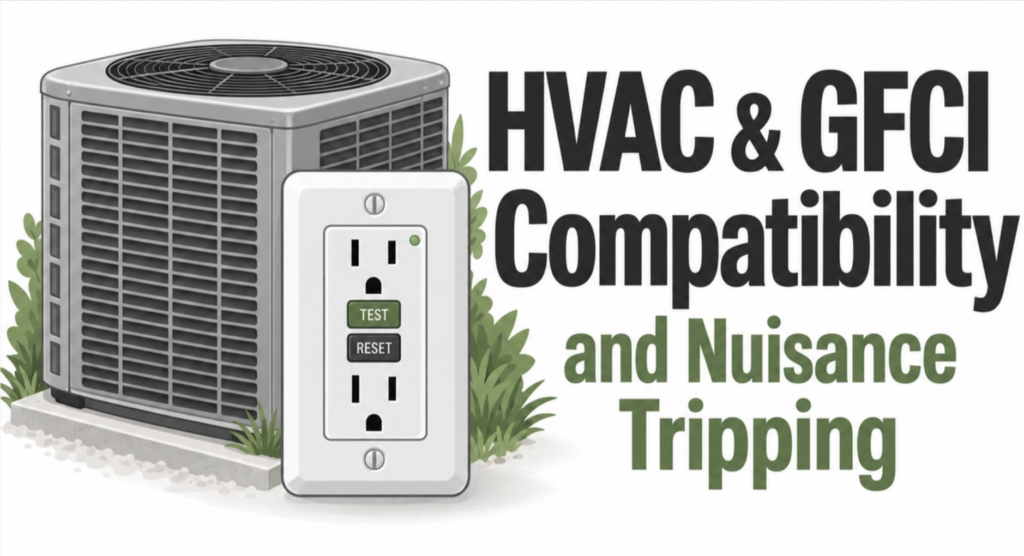
Why Is My Air Conditioner Tripping a GFCI Breaker?
If you recently installed a new air conditioner or heat pump and it keeps tripping a GFCI breaker, you may be wondering whether something is wrong with the equipment, the breaker, or your home’s electrical system.
The answer isn’t always simple.
Electrical and HVAC manufacturers have been studying an issue involving modern air-conditioning equipment and GFCI protection. In some cases, a properly operating HVAC system can cause a GFCI to trip even when there isn’t the type of electrical fault the GFCI is designed to protect against.
Here’s what homeowners should know.
First, What Is a GFCI?
GFCI stands for Ground-Fault Circuit Interrupter.
Most homeowners are familiar with GFCI outlets in bathrooms, kitchens, garages, and outdoor areas. They’re the receptacles with the TEST and RESET buttons.
A GFCI constantly monitors electricity flowing through a circuit. If it detects electricity going somewhere it shouldn’t—possibly through a person—it can shut the circuit off very quickly.
That makes GFCI protection an important electrical safety feature.
GFCI protection can also be built into a circuit breaker in your electrical panel, so there isn’t always a TEST and RESET button at the wall.
Why Would an Air Conditioner Need GFCI Protection?
The National Electrical Code (NEC) has expanded GFCI requirements over the years to provide additional protection against electrical shock.
One of those requirements is found in NEC Section 210.8(F) and deals with outdoor electrical outlets at homes.
Here’s where the terminology can get confusing.
In electrical-code language, an “outlet” doesn’t necessarily mean a receptacle where you plug something in. A permanently connected piece of equipment—such as your outdoor air-conditioning condenser—can also be supplied from an electrical outlet.
That means GFCI requirements can affect the circuit supplying your outdoor HVAC equipment.
The Problem With Some Modern HVAC Equipment
Today’s air conditioners and heat pumps are much more sophisticated than older systems.
Many newer units use:
- Variable-speed motors
- Inverter technology
- Electronic controls
- Power-conversion equipment
These features can improve comfort and energy efficiency, but they also change the electrical characteristics of the equipment.
Recent industry testing has found that some modern HVAC equipment produces small amounts of high-frequency electrical current that certain GFCI devices may interpret as a ground fault.
The GFCI trips—even though there may not be a dangerous ground fault present.
This is commonly called nuisance tripping.
It Doesn’t Necessarily Mean the Breaker or Air Conditioner Is Defective
One of the important findings from recent HVAC industry research is that there isn’t necessarily one defective product responsible for the problem.
Compatibility can depend on the particular combination of:
the HVAC equipment + the GFCI protecting it.
One air conditioner may operate normally with one GFCI design but experience repeated trips with another.
Researchers have also found that different GFCI designs can respond differently to the high-frequency electrical signals produced by modern HVAC equipment.
This is why simply replacing a breaker with another breaker may not always solve the problem.
Does That Mean You Should Remove the GFCI?
No.
A breaker that repeatedly trips should never simply be bypassed or replaced with different protection without determining why it is tripping.
A GFCI trip can still indicate a legitimate electrical problem, including:
- Damaged wiring
- Moisture intrusion
- Equipment failure
- Insulation problems
- An actual ground fault
The possibility of a compatibility issue doesn’t eliminate the possibility of a real electrical fault.
The circuit and equipment should be evaluated before assuming the trip is harmless.
The Electrical and HVAC Industries Are Working on the Problem
This issue has received considerable attention from electrical contractors, HVAC manufacturers, GFCI manufacturers, testing laboratories, and organizations responsible for electrical safety standards.
Testing by the Air-Conditioning, Heating, and Refrigeration Institute (AHRI) and the Electric Power Research Institute (EPRI) has helped identify why some combinations of HVAC equipment and GFCIs don’t work well together.
Manufacturers are now working on solutions, including:
- Changes to HVAC equipment
- Improved testing procedures
- GFCIs designed to better handle high-frequency electrical characteristics
- Updates to industry safety standards
The HVAC industry has also requested additional time from the National Fire Protection Association (NFPA) to allow manufacturers and testing organizations to complete this work.
The goal isn’t to eliminate GFCI protection. The goal is to make sure important electrical safety protection works reliably with modern HVAC equipment.
What Should You Do If Your AC Breaker Keeps Tripping?
If your outdoor air conditioner or heat pump repeatedly trips its breaker, don’t assume you simply have a “bad breaker.”
Also, don’t continue resetting it over and over.
A licensed electrician can check the circuit and determine whether there is an electrical problem that needs to be corrected.
Depending on the situation, troubleshooting may include checking:
- The breaker
- Circuit wiring
- Connections
- Equipment grounding
- The HVAC disconnect
- The air-conditioning equipment
- Manufacturer requirements
- The particular GFCI and HVAC equipment combination
Sometimes the electrician and HVAC contractor may need to work together to determine the cause.
The Bottom Line
Electrical codes continue to change as homes use more sophisticated electrical and electronic equipment.
GFCI protection remains an important safeguard against electrical shock. At the same time, manufacturers have learned that certain modern HVAC systems can interact with GFCI devices in ways that cause unwanted tripping.
That’s why diagnosing a tripping HVAC breaker requires more than simply replacing the breaker or assuming the air conditioner is defective.
If your air conditioner or heat pump is repeatedly tripping a breaker, have the electrical system evaluated by a qualified electrician.
Hual Electric can inspect the circuit, breaker, wiring, and connections to help determine whether you’re dealing with an electrical fault or a potential equipment compatibility issue.
Reference: https://www.mikeholt.com/newsletters.php?action=display&letterID=3041